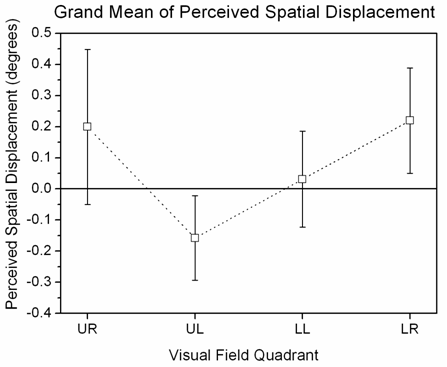
4. Perceived spatial displacement of motion-defined contours: Opposite biases between the upper-left and lower-right visual quadrants |
|
Quadrant-based analyses demonstrate opposite directions of perceived contour displacement in the upper left and lower right visual quadrants. In the lower right quadrant (LR, see below figure), the perceived contour displacement was in the direction of the more eccentric dots. However, in the upper left visual quadrant (UL, see below figure), the perceived contour displacement was in the opposite direction, e.g. the movement of the dots nearer to the fixation point. No significant displacement was found in the other two visual quadrants.
The result of Quadrant-based analyses is consistent with the result of hemifield-based analyses (Lower vs. Upper and Right vs. Left). This result pattern is likely depending on the relative strengths of two effects: a greater sensitivity to centripetal motion, and an asymmetry in the allocation of spatial attention.
|
|
|
|
|